Cope
Face it. Decide. Follow through.
Private AI counsel for the hard issues in your life: independent voices, a record you approve, and nothing of it on our servers.
- Keep climbing, or build something of my own?
- Is my marriage quiet, or over?
- What do I owe my parents, and what do I owe myself?
- How do I get ahead without becoming someone I don't like?
- Why have I put off the thing I keep saying I'll do?
- Or no question at all, only a sense that something isn't right.
Cope is an assistant for the issues in your life: a decision, a goal, a state you're stuck in, a relationship. The kind a chat assistant answers with a tidy, balanced list that leaves it where it was, or with the one confident answer you were hoping for.
No account needed. With your own key, nothing you say reaches us. Or sign in and ask us for credits.
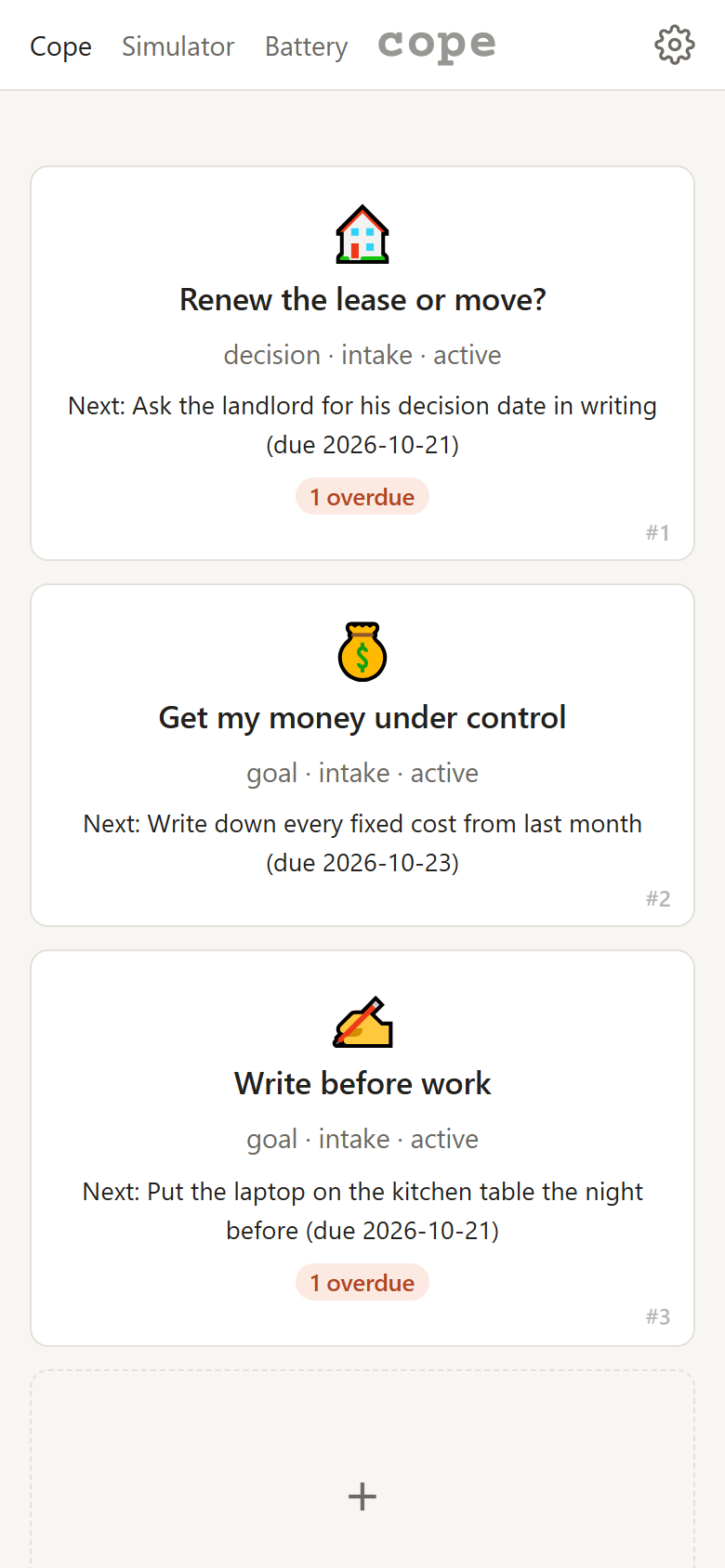
Independent voices
Consultants answer blind, each from a lens of its own, on two models by default. A question with an answer gets it plainly; where serious people split, you see both sides at full strength, and the choice is yours.
A record you approve
Nothing in your issue's document changes without your yes. Every step gets a date and an expected result; when you come back, Cope sets what happened beside what you expected, and the plan changes with the answer.
Nothing of it on our servers
No account needed. With your own key, your data stays on your device and nothing you say reaches us. Or sign in, and know exactly what we hold.
Together, and by call
Work an issue through with someone, each on your own device, with everyone's yes. Cope calls you at the hour you set about the plan you approved: what was due, what you expected, what came of it.
Start with a problem, or without one
Bring a problem
Say what's going on in your own words. Cope asks until it understands, and the issue starts from there.
Ask for a check-up
If you can't name a problem, a consultant goes through one area of your life (money, health, work, family and more) against what it holds, and asks whether you agree. Only the gaps you agree with go into your document. Offered once, when an issue starts.
Invite someone
Work an issue through live with a partner, a co-founder or a coach, each on your own device, with Cope mediating. Text for now. More below.
Check in, or be called
A check-in across your issues, typed or spoken: what's due, quick checks, the changes confirmed with one yes at the end, and one issue talked through. Cope calls you for it at the hour you set, through the app; by phone next, and you calling Cope from a walk.
One issue, one conversation, never ended
You pause it by leaving and resume it by coming back. After a break, Cope starts with a short recap and the actions that came due.
Nothing changes without your yes
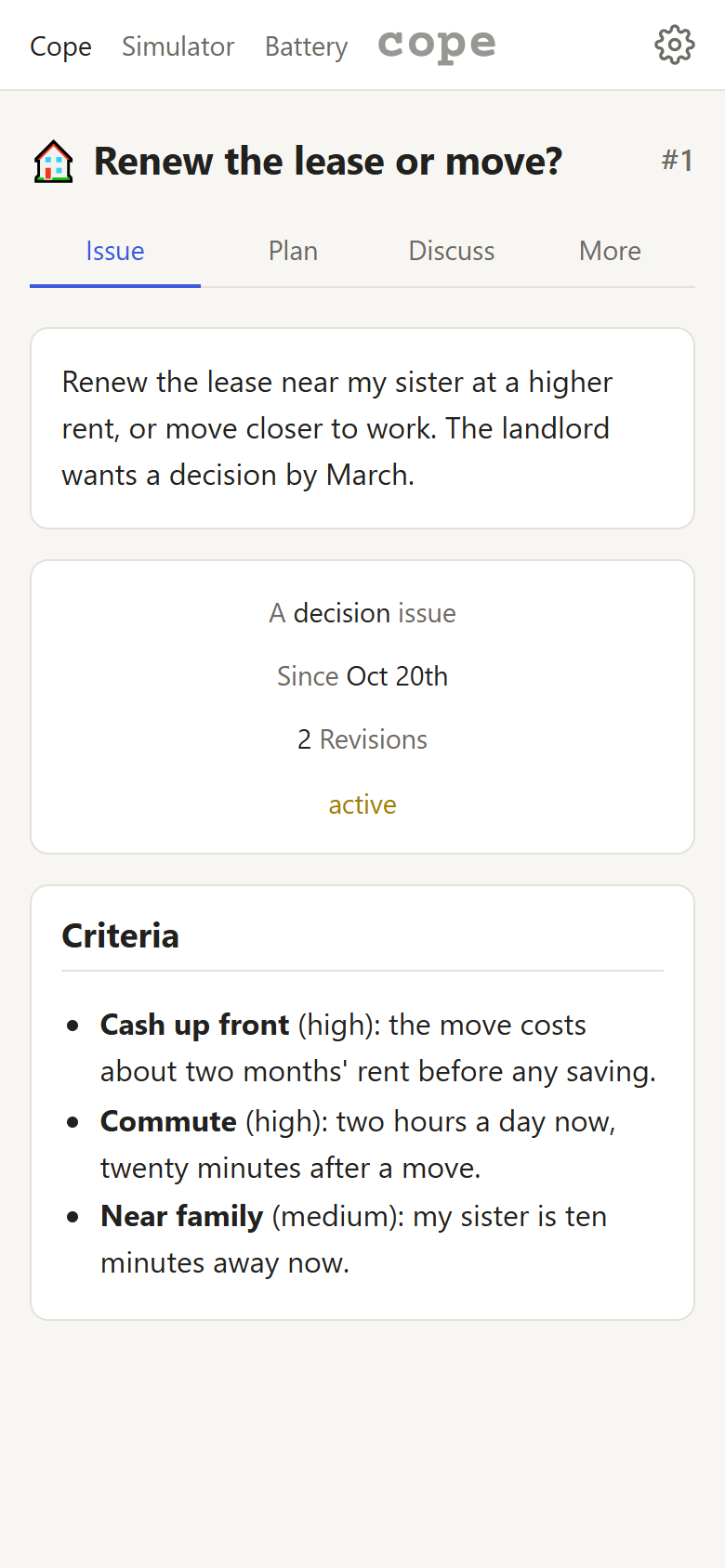
Cope suggests changes to your document at natural pauses, or when you ask, as a short list in the conversation. You answer Yes, No, or Discuss, and leave out any change you don't want.
Every accepted set of changes is a revision with a title and a reason, and you can undo it. Suggestions you turn down are remembered, so Cope knows what you've declined. An edit you make by hand is noticed and kept as a revision of its own.
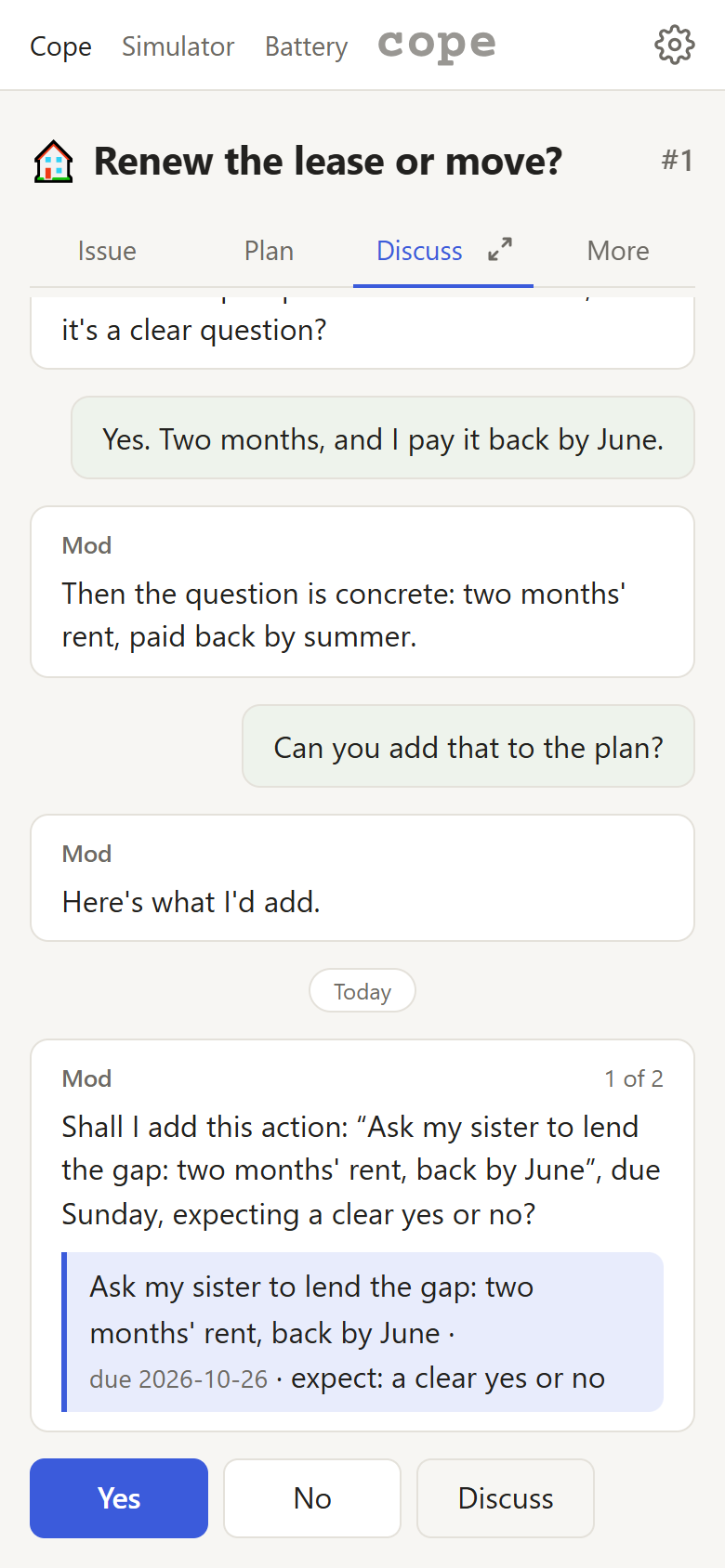
The document is yours
What the problem is, what you believe, the options and what you decided, and a plan of small dated actions, each with the outcome you expect.
Notes. Between conversations, write or dictate notes on an issue. No model reads a note until you share it, and the next conversation opens with the ones you did. A shared note is part of the conversation and can't be taken back.
Voice. You can talk instead of typing: Cope answers aloud, reads its suggestions out, and takes a spoken yes or no. Your browser's own voice, or OpenAI's, or Deepgram and ElevenLabs', on your keys or ours.
Follow-through, not advice
A daily reminder tells you what's due. Coming back, Cope goes through what was due, asks what actually happened, compares it with what you expected, and says what that means for the next step. From a simulated run in the showcase, a week after the plan was set:
Actually before I go — I should be honest. I didn't have the conversation. I kept Tuesday open all week and just... never booked it with him. I did the one-pager though.
CopeWelcome back. The plan was: conversation by Oct 28, the one-pager by Nov 2. So the picture's flipped from what we'd hoped — the conversation never got booked, and the one-pager did. … The safe task got done and the scary ask got skipped. That's the exact pattern this whole goal has been circling, so it's not a failure, it's data about where the resistance really is. … Is the plan still to have it — just rebooked for a new day — or has something shifted and you're not sure you want it anymore?
It's still the plan. I want it. I just... every time I thought about booking it, something came up that felt more urgent.
CopeThis is exactly what the Elder is for — naming what you're avoiding and the cost of the moment that never arrives. Let me put it to them.
The Elder answers, in full; then:
CopeThe next sixty seconds is the whole thing. So: which day this week are you booking it for? Pick one now, and send the invite before you close this.
Okay. Thursday. I'll put 30 minutes on his calendar for Thursday afternoon and say I want to talk about the promotion path. That's it, that's the message.
CopeThursday afternoon, 30 minutes, "promotion path" — that's the whole ask in one clean line. Send it now, while it's in your hands, before the urgent stuff finds you again. And the one-pager — you said you did it. Did you draft it only, or did you actually send it to him too?
The same simulated person as the panel further down, two visits on. Read the whole issue in the showcase.
Independent voices, and the choice handed back
One capable model, asked a hard question, finds the safe middle and gives it to you in one voice. Asked for both sides, it writes both already knowing how it wants them to end. Cope keeps its voices apart instead, so that when they agree, the agreement means more, and when they split, the split is real. Council apps keep models apart too; Cope's voices each hold a stance of their own, and a split comes back to you by kind. It doesn't stage a fight: most questions get an answer. This is the bet the whole thing rests on.
A cast of lenses
Where another view helps, Cope calls in consultants: 32 distinct voices, each holding a developed position on one part of life and naming the thinkers behind it. The Treasurer on money behavior, the Serpent and the Convener on power, the Rake and the Match on attraction and compatibility, the Elder on what you're avoiding, the Scout on deciding under uncertainty. For one round, one to three of them answer the same question without seeing each other, on two models by default, and you read every answer in full. The second voice is a second mind, not the first one in a mask.
They speak without a chaperone: no softening, no moralizing, as a knowledgeable friend would in private. Cope runs the conversation; the consultants bring the substance.
Read a real panel
From a simulated run in the showcase, on DeepSeek: a product manager three months from a promotion decision, whose manager said "close" and no more. Three consultants, one question; their answers are cut to a few lines each.
CopeThe real gap is information, not effort, so I'm asking Serpent, Convener, and Negotiator the same question: how to learn the rules of that room fast, and how to make the ask you've been avoiding.
The SerpentYou're right to treat this as an information war, not an effort war. … It's to ask for the mechanics of the room without flinching. … How they answer tells you whether you have an advocate or a courier.
The ConvenerYour manager is also being evaluated in calibration. They have to stand up in front of peers and defend you. If you're vague to them, they're vague for you. … The people who get promoted aren't the ones who did the most work. They're the ones who made it effortless for someone to argue on their behalf.
The NegotiatorA negotiation without a written artifact is just a vibe, and you already have too many vibes. … Know your alternative. … A person with a plan doesn't flinch at a "no." That steadiness is the whole game.
CopeAll three land on the same move: have the manager conversation now, but framed as building the evidence for the room … That framing also tests whether you have an advocate or just a courier. … The Negotiator: if the answer comes back "close, but not this year" — what then? Do you stay, or start looking quietly?
Later in the same issue, two of them split over one word of the opening line: whether "arguing for me" presumes a role the manager hasn't taken. Cope's note on the split: "This depends on a fact you may not know yet: whether this manager genuinely fights in the room."
Read the whole issue in the showcase, with the judge's scores beside it.
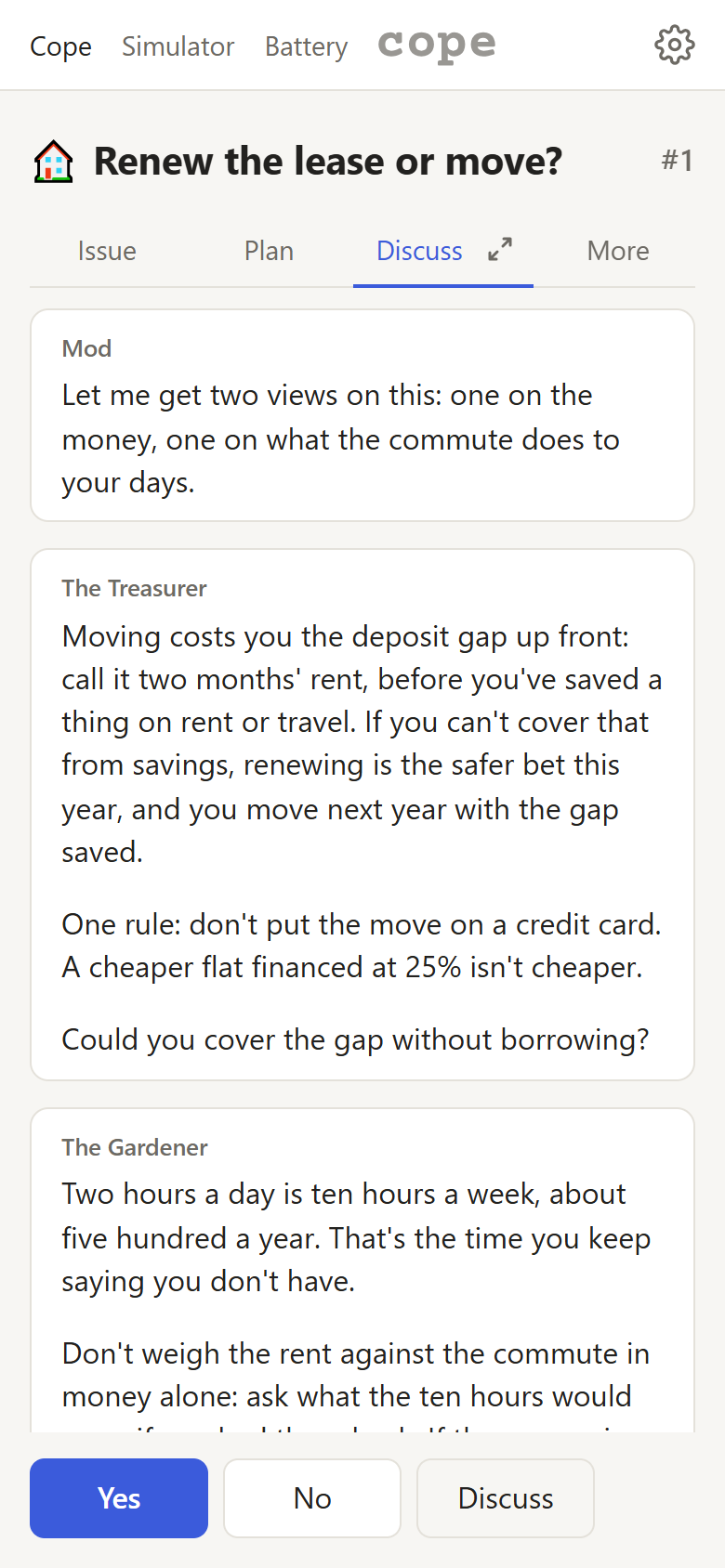
Disagreement handed back, by kind
After a panel, Cope writes what they agree on, where they pull apart, and passes on every question they asked you. Where serious people would split, you see both sides at full strength, not an average nobody holds; where a question has a plain answer, you get it plainly. Then the part most advice apps skip: when the consultants disagree, who is right? Cope neither picks nor averages. It says what the disagreement is about. A fact nobody has yet: finding it out becomes the next step. A prediction: you make the bet, with the result you expect, and Cope checks it when the date comes. What matters to you: that one is yours, and Cope says so.
What a step costs elsewhere next
A plan for the promotion can cost the sleep you mentioned three weeks ago, or the evenings a relationship runs on. When a concrete step lands in your plan, the consultants for the parts of your life it touches get a line on what it costs there. Only the cost of a step already on the table, never a problem you didn't bring, and not one you have already weighed. Cope then names the trade-off and leaves it to you, or folds it into the plan when a change of date dissolves it.
A record of your judgment experimental
Across your issues, Cope keeps what it learns about you only as entries you approve one by one: facts about your life, and how you think and decide, in your own words. Beside them, a digest of your past decisions: the forks you stood at, which way you went, what you expected and what happened. When a new choice rhymes with an old one, Cope says so and asks whether the comparison holds. You edit the list yourself, and none of it goes into a shared issue. Our first simulated runs show no sign yet that it helps; it is off until you switch it on.
Yours to change, or to switch off
You choose who's in the room. Write your own consultants and playbooks beside Cope's, in plain text, test them in the same simulator we use, and publish them for anyone to install. Importing someone else's comes with a plain warning: their voices will work on your problems, and Cope has no safety layer between them and you. Or switch every consultant off: Cope is still the issue, the document and the plan.
Someone to call about the hard stuff
An assistant you can phone, and that phones you. A check-in at the hour you choose, about what's due and the one issue worth a few minutes today. A walk where you think an issue through out loud. Tasks captured by voice into the issue they belong to.
Today Cope calls you through the app: at the hour you set, your phone rings, and you pick up, put it off by ten minutes or an hour, or reject it. Picking up opens the check-in by voice. It remembers what was due and what you expected, brings in a consultant when another view helps, and every new step gets a date and an expected result, confirmed with one yes.
One assistant, one voice. Nothing private on voicemail, or before you've said it's a good time. A phone number, and you calling Cope from a walk, come next.
A morning check-in, on a walk
A designed illustration of the call as it will be by phone: the words are written by us and performed by synthetic voices. Today the call comes through the app, and the check-in it opens is the real thing.
Read the call
An incoming ring, the pickup
Yeah?
CopeMorning, it's Cope. Good time for five minutes?
Yeah, I'm out walking.
CopeTwo quick things, then the flat. Did you book the dentist? It was due yesterday.
Forgot. Again.
CopeFriday?
Friday.
CopeAnd the landlord: you expected an answer by today.
He did answer. He wants a decision by March.
CopeSo: dentist Friday, and the landlord's deadline is March, noted in the flat. Right?
Yes.
CopeOn the flat, you're torn between renewing and moving. Let's get a second view from the Treasurer on the money side.
The TreasurerMoving's going to cost you the deposit gap up front. Call it two months' rent, before you've saved a thing. And if you can't cover that without borrowing, renewing's the safer bet.
Hold on, crossing… …OK. The gap is the problem. My sister might lend it.
CopeThen that's the next step. Ask your sister by Sunday, and you expect a clear yes or no. Shall I add that?
Yes.
CopeDone. Dentist Friday, sister by Sunday, decision by March. Talk tomorrow at 8:30.
Great, thanks.
Some issues belong to more than one person
A couple's money, a company two founders run, a parent that siblings look after, a coach's work with a client. Invite someone into an issue (Invite, on its More tab) and you work it through together, live, each on your own device. Up to three of you.
- Cope mediates. It answers once everyone has spoken or passed, and treats what each person says as that person's account, not the facts. It takes no side and doesn't tell one of you what the other really means. A disagreement you can't settle yet is written down as one, each view with its owner's name.
- Everyone's yes. Everyone gets the same suggestions and answers them on their own device. A change goes into the document only if everyone says yes; anyone can leave it out or ask to discuss it.
- Everyone keeps the record. Each person has a full copy of the issue. It moves on only while everyone is there, so the copies never disagree; between sessions it's read-only for all of you, and each of you is reminded of what's due.
- Nothing hidden. Whoever you send the link to sees everything in the issue, the whole conversation and every revision, and Cope tells you so before you send it. No one has a private thread.
How the connection works, and what's next
- The one who invites pays, and the person invited needs no keys of their own: the conversation runs on the inviting person's device. Your browsers connect directly where your networks allow, else relayed through Cope's server, everything between them encrypted end to end under a key in the link that our server never sees. Each device proves itself to the others: the host lets a person in once and knows their device after that. On a direct connection you see each other's internet address.
- Text for now. Voice in a shared issue and the conversation on a phone come next; after them, in your account, taking turns at different times while the host is away.
Keep ChatGPT. Bring the issues that run for weeks here.
For thinking one question through today, a frontier chat is as good as Cope or better, faster, and already paid for. In our own test, a plain chat on the same model came out even with Cope on a single problem. Cope is built for what a chat isn't: the issue that is still there next month.
- A record you approve, not a memory written about you. A chat assistant writes its own notes about you as you talk; you find out what it kept afterwards. Cope changes nothing without your yes, keeps every change as a revision you can undo, and keeps what it knows about you as entries you approved one by one.
- A plan that is checked, not a conversation that ends. Each step gets a date and an expected result, and when you come back Cope asks what actually happened and what that says about the next step. A chat carries what it remembers of you, not a plan it comes back to.
- Voices with a stance of their own, not one voice. Asked for both sides, one model writes both already knowing how it wants them to end. Council apps run several models apart, with a chair's answer as the result. Cope's consultants each hold a stance of their own, answer blind on two models by default, and where they split, the split comes back to you by kind: a fact to find out, a prediction to check, a call that is yours.
- Nothing of it on our servers, account or not. A chat assistant runs on its maker's servers; what you say is stored there, with or without an account. With your own key, Cope keeps your issues on your device and nothing you say reaches us; sign in only if you want us to hold them.
- An issue two people work through, with everyone's yes. In a chat the assistant answers whoever typed last, and nothing is held in common. Cope keeps one issue that is both of yours, each on your own device, and it changes only when all of you say yes.
Each does one part of it well
By kind of product, with one checked example each. What a row says is about the kind of thing a product is, not a feature it lacks this month.
| Kind of product | What it does well | What it lacks |
|---|---|---|
| General assistants (ChatGPT) | Think a hard question through today; voice; reminders | Memory the model writes on its own; no plan checked against what happened; no record of how your decisions turned out; a safe middle in one voice |
| Assistants that call you (Martin) | A call about your day | Your calendar and inbox read out to you: nothing you say changes a record of yours |
| Coaches that call you (Some Week) | A phone call at the hour you set that asks how it went | A diary the coach keeps and a metric: nothing records what you expected, and what you say changes no plan you own |
| AI life coaches (Pensy) | Sessions at the hours you set, commitments checked at the next one, memory you can correct, no streaks | The coach writes the record and you correct it afterwards: nothing records what you expected, one voice answers, and it all lives on its servers |
| AI journaling (Rosebud) | Reflection over time | A journal that reflects your feelings back, with streaks to keep you writing: a decision and what came of it are nobody's record |
| Decision journals and prediction trackers (Fatebook) | Asks how it turned out when the date comes, and scores your calibration | One forecast at a time, graded by you alone: nothing thinks the decision through with you first, and the answer changes no plan |
| Council apps (Perplexity's Model Council) | Several models answer the same question at once, and a synthesis shows where they agree and differ | Built around the question, not around you: the voices are models with no stance of their own, the answer is the chair's, and the chat it lands in is where it ends |
| Templates and notes (Notion) | A record | Nothing pushes back or asks how it turned out |
You don't have to trust us with anything
Cope asks you about the things you'd least want on a server: your marriage, your boss, your money, what the Serpent told you to do. So it's built so that they need not be on ours. No account, no email, no sign-up: open the app with your own API key, and nothing you say or write reaches us. We built this, and your data isn't what we're after.
How far you can take it. Three steps, each with one party fewer in your conversation.
- Signed in, on Cope's models. Your conversations pass through our server on their way to the providers, and stay in your account if you keep your data there.
- Your own key. Only the model provider you chose sees them, under its own API terms, and the app names it before the first call. Your data stays on your device.
- Your own model, on your own machine. Nobody. In the terminal client not a word leaves it; the browser app makes one request to our host, to load, and no other. We've written up the setup, and we're measuring which models carry a Cope conversation. The same works with a model server run by someone you trust, for their circle: they see what the model sees. The guide for both is coming.
Voice is the exception: speech goes to the browser's maker or to the voice provider you choose, so the last step is typed.
What reaches us on every step, exactly. Loading the app from copeai.app is a request to our host like any website's; the terminal client makes none. The daily reminder, if you turn it on, hands our relay times and ciphertext it can't read. Inviting someone into an issue hands our rooms your devices' addresses, and everything between you is encrypted end to end. None of these carries a word you wrote.
If you'd rather we hold your data, you can, and this is exactly what that means. Privacy or convenience is your choice, and we recommend neither. Two choices, made apart: whose keys, and where your data lives.
Whose keys
Your own API keys, signed in or not: your conversations go only to the model providers you choose, at what they charge. Or sign in, with just your email, for Cope's models through CopeRouter, our route to them: no key of your own, at their makers' prices plus a small margin, paid with Cope credits (free for feedback). Then your conversations pass through our server on their way to the providers. Signing in alone sends us nothing, and until your account has credits, Cope's models don't run.
Where your data lives
On your device, always supported: the browser or terminal app, with or without an account. Or, signed in, in your account on Cope's server, the same on every device you sign in on. Moving between the two is one folder copied across.
Compare the two in detail
| On your device | In your account | |
|---|---|---|
| Who sees your issues | You, the model providers you choose (nobody else, with a model on your own machine), and our server only while you use Cope's models | Also Cope's server, which keeps them |
| Several devices | A copy each; move it with an export and an import | The same data on every device, nothing to sync |
| Clearing the browser | Takes your data with it, unless you kept a copy: a file, or your Google Drive | Your data stays on the server |
| People sharing a browser | A profile each, with a passphrase if you want one | A profile each, signed in to its own account |
| Models | Any provider with your own key, a model on your own machine or a server you trust, or Cope's when signed in | The same |
| What you pay | The providers' price with your own keys; Cope credits for Cope's models | The same |
| Setup and upkeep | Your own keys or a sign-in, and copies to back up or move your data | Sign in, and your own keys on each device if you use them |
| Daily reminder | Yes | Yes |
| Cope calling you | In the app | In the app |
| Phone calls (coming) | No | Yes |
| Shared issues | Yes, live | Yes, live |
| A shared issue while its host is away (coming) | No: the host's device runs it | Yes |
| A public link to an issue | No | Yes: read-only, for anyone with the address, until you turn it off |
| If Cope's server is down or gone | Keeps working with your own keys | Stops |
A feature needs a server only if it has to act while none of your apps are open (a call at 8:30) or something from outside has to reach Cope (you dialing its number). Everything else works on your device. Moving your data between your device and your account is one folder copied across, so you can always leave with everything.
Cope comes with its own test bench
In the simulator, AI users bringing real kinds of problems use the real app over several visits, and a judge model scores each run blind, on a written rubric. A second test plays the same problem against the same model with nothing of Cope around it, a plain chat with one frontier model, and a judge compares the two conversations, in both orders so the order doesn't decide. New parts are tested the same way: the check-up also meets a simulated person whose money is in order, to catch it inventing problems, and a shared issue is played with a simulated person on each side.
- We publish the results, good or bad. Claims about helping people with their lives are easy to make; we want to show that Cope works, and keep showing it, including when it doesn't. So far: the first comparison with a plain chat came out even, and About you's first three simulated runs showed no sign yet that it helps, and a wrong entry in the list was checked rather than followed.
- Anyone can run it. The simulator runs in the browser app, on your own keys or your credits, with your own simulated people and scenarios beside ours and your own cast, so you can test your own problems, your own changes, or check our claims.
- It's a research question too. Does a room of opinionated voices, run by a moderator, help a person more than one capable model on its own? Work on multi-agent systems asks something like it, mostly on tasks with right answers; Cope asks it about personal problems, where "better" is judged against a rubric. The answer could go either way, and we'll publish it either way.
Five of those simulated people are open to read: their issues as they left them in the app, and the same runs in the simulator with their judgements.
Write a consultant. Test it. Publish it.
Cope's cast is a starting point, not the last word. The method is plain text: a consultant is a page that says what it holds and whose thinking it stands on, and a playbook is a page on how a kind of problem is worked through. Someone who has lived a co-founder dispute, bought a first home, raised a child with ADHD or run a small restaurant knows things no general assistant will say with conviction. They can write that voice. A coach can write playbooks for their clients; a community can build a room of its own, a Stoic room or a founders' room. Cope's own consultants and playbooks stay as they are: you can choose them, not rewrite them.
- Write it in the app. Your own consultants and playbooks sit beside Cope's, switched on and off like the rest, and Cope calls them in when their lens fits.
- Test it before you trust it. Run it in the simulator against our simulated people or your own, read the panels, and judge the runs blind on the same rubric we use.
- Publish it. Signed in, publish it under a handle you choose to the community page, where anyone reads the prompts and installs them with one click, with the same plain warning every pack carries. We read every listing before it goes public, and a listing shows how many have installed it, no ratings.
- What it earns. Today an accepted pack earns its author Cope credits. A share for authors of what their work earns is for later, once Cope itself earns.
Try it on us
Cope is new, and what we need most is people using it on a real problem and telling us how it went. Write us a few lines: what you'd like to try, and a line about you. We read every request, usually within a few days, and while places last we add $5 of Cope credits to your account to start. Use it for real, tell us what you think, and there's more.
- Your feedback is what you write to us. We never read it out of your conversations.
- Nothing public is asked. No reviews, posts or ratings: we want to hear what didn't work as much as what did.
- Found a bug? Search the bug tracker first, and add yours there if it's new: the first report of a bug, with the steps to reproduce it, earns credits. No account? Write to info@copeai.app and we'll file it for you.
- Other help earns credits too: consultants and playbooks others can import; judging simulator runs blind, to check our judge against people; and trying what no stranger has tried yet: signing in from an Outlook address, reminders and calls on a phone, a shared issue with someone.
The honest limits
- Not a therapist or a crisis service. Cope has no safety layer today: no crisis detection, no hotline prompts, and the consultants speak without softening. A check-up raises hard subjects on its own (your inner life, a partner, your family).
- Not built to keep you talking. Each issue is meant to end. The assistant will call only on the schedule you set or when something in your plan is due, and it looks for problems only when you ask for a check-up.
- What it costs. Each conversation is real model calls at the providers' prices, which depend on the models you choose; the cost is shown per issue. Cope's models through CopeRouter cost their makers' prices plus a small margin, paid with Cope credits; with your own keys you pay only the providers.
- Where it could fail. You may tap yes without reading. A record of your decisions can pin you to a self you've outgrown. Voices from one model can sound like one voice in masks. Talking a problem through can become a way of not acting on it. A check-up can talk you into a problem you don't have, or measure your life against a standard that isn't yours. In a shared issue, one person can press another into a yes, and Cope's refusal to take sides is no protection against that. These are the risks of the very features that make Cope worth using, and we name them so you can watch for them.
Why Cope
What we believe, in a line each. The argument for each is on the manifesto page, with what Cope will not do and how we keep it honest.
- A problem isn't a conversation.
- Your keys, your device, your files.
- The record is yours.
- Advice is cheap; following through is the work.
- An assistant should be reachable the way a person is.
- Disagreement is information.
- Not every disagreement is the same kind.
- Some problems belong to more than one person.
- It treats you as an adult.
- A check-up has opinions.
- Each issue is meant to end.